
This morning I had a little invitation from a local VW dealer. Yes, I was offered the opportunity to review a 2009 Jetta TDI and I am seriously going to consider it. Sure, I have a high amount of affinity for fuel efficient hybrid technology but I still believe cleaner Diesel tech has a very important role to play in our immediate future. ;)
Anyway, I hope the dealer understands that unlike most folks testing their cars, I will be walking into their dealership with a scangauge in hand and a dead-serious desire to drive the demo unit into the lowest L/100km I can get.
As soon as I get enough information and driving impressions on this vehicle I will publish the review at CleanMPG. In the meantime I'll post the little bits of info as I get them.
Monday, March 23, 2009


Saturday, March 21, 2009
Installing the LED taillights
After looking at the boxes for several days I decided I would give  the installation a shot. Each box arrived with a different set of tail lights. I picked a set and opted to get my hands dirty with the task of prepping the car for the tail light replacement. This also meant securing an old blanket where I could temporarily rest the bumper and the taillights while working on the car.
 the installation a shot. Each box arrived with a different set of tail lights. I picked a set and opted to get my hands dirty with the task of prepping the car for the tail light replacement. This also meant securing an old blanket where I could temporarily rest the bumper and the taillights while working on the car.
The following is a brief summary of the major steps taken during this retrofit. A good set of tools is a must to avoid damaging the new and the OEM parts.
- If you have rear mudflaps you may have to remove them. To do this well you may also need to remove the rear wheels since we may not have enough clearance to remove the flaps.

- Then you have to remove a total of 4 screws on each side of the rear wheel well that are holding the bumper in place. Take care to note which screws go where in order to reverse the procedure later on - yes they are all slightly different.
- Then it is a matter on unbolting two high mounted screws (under the trunk lid) with a hex key and then carefully pop off the two clips at the bottom of the bumper.
- Once this hardware is out of the way and with the help of an assistant we pull out the bumper starting from the ends at each wheel well. An assistant will help hold the lightweight bumper without it falling on the ground - remember the bumper is a painted surface.
- The next step is to remove the trunk lining out of the way enough to gain access to each tail light. Remove the connectors and bulb from each taillight and take note which bulb came from which orifice.
- You need a good wrench to remove a total of 4 nuts out of each taillight.
 Once the nuts are removed we need to loosen up the metal bracket holding up each tail light. The single screw attaching the metal bracket to the bottom of the tail light also needs to come off completely. We do this to both taillights and gently remove the units.
 - At this stage you are ready to unpack then new tail lights and slide them into the appropriate locations.
- Perform a readiness test before bolting everything back in. This may include pressing the brake pedal, turning on the marker lights and the hazard lights. If all looks good simply bolt everything back to the way it was. Make sure the water seal is properly positioned around the inner edge of the taillights otherwise you may end-up with some water in your trunk after a car wash.


Some words of caution...
Make sure that you insert the new taillight connectors into the OEM wiring harness carefully since these are not as smooth and rounded as the OEM bulbs were and you may crumple the internal contacts in the OEM harness.
Also, as you may notice one of the new tail lights has a bad LED. I will be exchanging this one one of these days.
Was it worth it?
That's what I will be assessing over the next few days. At some point the full review of this accessory will be posted at www.CleanMPG.com. Anyway, the whole setup took about two hours to complete especially after you include the inner (trunk lid mounted) tail lights.
Here's a little video showing the tail lights in action. The side marker lights are on as well as the hazards.
Cheers;
Tuesday, March 3, 2009
Adding LED tailights to the HCH-II
A local group of HCH-II owners agreed to review a set of HCH-II tail lights that run mostly on high intensity LED arrays. These tail lights are complete assemblies that match the size of the OEM tail lights and only use a single stock incandescent bulb used for the backup light. The remaining light clusters are strictly LED based and the complete units are OEM plug and play.
Oh, yes. These units are DOT approved too. Here's a sample:

The candidate units will be Altezza, APC and ANZO branded and we will report on how they perform in terms of power usage. We expect these to perform as well as the OEM units in terms of lighting effectiveness, but we are not sure if these will actually consume less power. As you may know, the upcoming Toyota Prius has this feature and so does the 2009 Honda Insight. For good reasons, LED tail lights are expected to save a few percent in nominal energy over the more traditional lighting.
We have ours fingers crossed... as these tail light units are very expensive roughly $250 to $400 so we hope they work. If they don't, well... at least they will look OK.
Oh, yes. These units are DOT approved too. Here's a sample:

The candidate units will be Altezza, APC and ANZO branded and we will report on how they perform in terms of power usage. We expect these to perform as well as the OEM units in terms of lighting effectiveness, but we are not sure if these will actually consume less power. As you may know, the upcoming Toyota Prius has this feature and so does the 2009 Honda Insight. For good reasons, LED tail lights are expected to save a few percent in nominal energy over the more traditional lighting.
We have ours fingers crossed... as these tail light units are very expensive roughly $250 to $400 so we hope they work. If they don't, well... at least they will look OK.
Thursday, February 26, 2009
Update on the latest software updates for the HCH-II
Well, a couple of months have passed and I have a much better idea whether the latest updates actually improved things with regards to the occasional SoC crashes. Please check this post for actuall update details:
Software update part numbers
First let me summarize what the current behavior now is:
I'll post additional info as soon as I get more information on this issue.
Software update part numbers
First let me summarize what the current behavior now is:
- Regen affinity is much higher during low throttle conditions while is the ICE is cold. This relates to the early temperature transition stages (S0 through S3).
- When SoC descends to 5 bars a forced regen is induced as it did before when it dipped below 5.
- SoC crashes still happen but these are detected before the SoC dips below 5 bars.
- Forced regens stop when the SoC reaches a full 8 bars
- Finally, forced regens usually jump from an SoC of 6 bars to 8. No smooth transitions as they did before.
I'll post additional info as soon as I get more information on this issue.
Monday, February 9, 2009
Life Cycle assessment for Honda and Toyota hybrids (HCH-II & Prius II)
I recently re-discovered a chart that had originally been published in one on Honda's 2007 environmental reports. In this chart Honda illustrates how much CO2 the Civic Hybrid produces above its gasoline only powered counterpart. The graph identifies the volume of CO2 produced during its first 100,000 Kilometers (62,000 miles) and it also identifies which aspect of the cars life (from production to use and disposal) contributes the most.
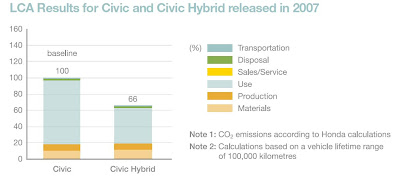
Let us just say, that when it comes to energy usage the Civic Hybrid produces far less CO2 and requires measurably less energy to operate for the first 100,000 km. Can you imagine how much of a discrepancy there would be if the study had been extended to 200,000 km?
What about the Toyota Prius, the most popular and ubiquitous hybrid in the world?

Pretty educational isn't it?
A few words:
Since these two graphs were published by the two largest global producers of of Hybrid electric vehicles in the world, they carry a fair amount of similarities and results. What is remarkable is that despite the additional amount of resources and energy their fuel efficient and capable HEV consume during their production, they will require relatively little time and mileage to best their conventionally powered siblings.
Yes, these graphs were provided by both Honda and Toyota and not an independent source but it is the best and most authoritative we can get, which is far more than the shameful guesswork CNW did during their much controversial study.
No wonder CNW never allowed their work and claims to be peer reviewed. :(

Let us just say, that when it comes to energy usage the Civic Hybrid produces far less CO2 and requires measurably less energy to operate for the first 100,000 km. Can you imagine how much of a discrepancy there would be if the study had been extended to 200,000 km?
What about the Toyota Prius, the most popular and ubiquitous hybrid in the world?

Pretty educational isn't it?
A few words:
Since these two graphs were published by the two largest global producers of of Hybrid electric vehicles in the world, they carry a fair amount of similarities and results. What is remarkable is that despite the additional amount of resources and energy their fuel efficient and capable HEV consume during their production, they will require relatively little time and mileage to best their conventionally powered siblings.
Yes, these graphs were provided by both Honda and Toyota and not an independent source but it is the best and most authoritative we can get, which is far more than the shameful guesswork CNW did during their much controversial study.
No wonder CNW never allowed their work and claims to be peer reviewed. :(
Tuesday, January 13, 2009
The Prius Detroit Connection event
Toyota issued invitations to 50 of the most active Prius owners to attend the unveiling of the new 2010 Toyota Prius in Detroit during the NAIAS event. We had folks from all over the continent (US and Canada) as well as Pat Sparks from Australia. Most of these folks were members of online communities (CleanMPG and PriusChat - both of which I am a member) and we not only had an opportunity to rub shoulders but we also managed to have a hands on experience with 3 distinct trim levels of the upcoming 2010 Prius.
Special thanks goes to Toyota for the extremely well organized event as well as the online community who tirelessly continue to make the Toyota Prius the pinnacle of excellence in the automotive world.
Anyhow, here are a few videos for your enjoyment:
The following is a detailed video of the power-train components (ICE and HSD). Please note the engine, the exhaust recirculation system and the more compact battery pack+cooling packaging.
The next two videos capture an interactive kiosk display that highlights the new developments on the 2010 Prius.
Special thanks goes to Toyota for the extremely well organized event as well as the online community who tirelessly continue to make the Toyota Prius the pinnacle of excellence in the automotive world.
Anyhow, here are a few videos for your enjoyment:
The following is a detailed video of the power-train components (ICE and HSD). Please note the engine, the exhaust recirculation system and the more compact battery pack+cooling packaging.
The next two videos capture an interactive kiosk display that highlights the new developments on the 2010 Prius.
Monday, January 12, 2009
Live from NAIAS (Detroit) and the Prius 2010 PDC event
This years's North American International Auto Show event was underscored by the introductions of two very important vehicles: The 2010 third generation Toyota Prius and the 2010 second generation Honda Insight.
Here are some videos of the event:
The 2010 Honda Insight
The 2010 Toyota Prius
More to come ...
Here are some videos of the event:
The 2010 Honda Insight
The 2010 Toyota Prius
More to come ...
Friday, December 26, 2008
New HCH-II software updates (Winter 2008)
I had promised a few months ago that I would send notice of new software updates for owners of 2006, 2007 and some 2008 models. I have not confirmed if one or all of these updates apply to newly produced 2009 models.
This is it folks. We have a new batch of software updates that are purported to address some of the issues experienced by owners of the said model years.
Since at the moment I can only mention part numbers and a description, I am hopeful that this will be enough when you request the application of the updates from your dealer. If this is not enough then please let me know and I'll fetch additional info on these part numbers.
Part# 19301PMX306
Desc: PGM-FI Update + additional update
Part# 37820-RMX-A53
Desc: Battery Initial Calibration
Part# 1K100-RMX-A06 (S/B# 01-084...)
Desc: Battery Update + additional update
Part# 1K100-RMX-A06 (S/B# 03-002...)
Desc: Motor Update + additional update
I will be scheduling an appointment from my local dealer to have these updates applied to my two HCH-II's and hopefully some of you will be able to do the same at some point.
Perhaps these updates will offer an improvement for some of the issues concerning the community over the last year or so. ;)
This is it folks. We have a new batch of software updates that are purported to address some of the issues experienced by owners of the said model years.
Since at the moment I can only mention part numbers and a description, I am hopeful that this will be enough when you request the application of the updates from your dealer. If this is not enough then please let me know and I'll fetch additional info on these part numbers.
Part# 19301PMX306
Desc: PGM-FI Update + additional update
Part# 37820-RMX-A53
Desc: Battery Initial Calibration
Part# 1K100-RMX-A06 (S/B# 01-084...)
Desc: Battery Update + additional update
Part# 1K100-RMX-A06 (S/B# 03-002...)
Desc: Motor Update + additional update
I will be scheduling an appointment from my local dealer to have these updates applied to my two HCH-II's and hopefully some of you will be able to do the same at some point.
Perhaps these updates will offer an improvement for some of the issues concerning the community over the last year or so. ;)
Thursday, November 20, 2008
The Honda Civic Hybrid (HCH-II FAQ) Frequently Asked Questions
This one has taken me a fair amount of time to complete... you know, in the priority list of things to do some of those things end-up taking a bit longer.

Anyhow, this FAQ article is a must read by any HCH-II owner as well as anyone else looking to purchasing one.
The Second generation Honda Civic Hybrid FAQ
Enjoy.

Anyhow, this FAQ article is a must read by any HCH-II owner as well as anyone else looking to purchasing one.
The Second generation Honda Civic Hybrid FAQ
Enjoy.
Monday, November 3, 2008
A Hybrid Owner’s winter survival guide
Yes, after almost 14 months it is complete and you may find it here:

A Hybrid Owner’s winter survival guide
My hope is that this article will help Prius and HCH-II owners overcome the fuel economy hit due to winter time driving. As with anything else in life, a bit of knowledge and upfront preparation can do wonders for your emissions and fuel economy.
Highlight: Temperature transition table for the Prius-II

Highlight: Temperature transition table for the HCH-II

You'll find a lot more detail in that article.
Enjoy :)

A Hybrid Owner’s winter survival guide
My hope is that this article will help Prius and HCH-II owners overcome the fuel economy hit due to winter time driving. As with anything else in life, a bit of knowledge and upfront preparation can do wonders for your emissions and fuel economy.
Highlight: Temperature transition table for the Prius-II

Highlight: Temperature transition table for the HCH-II

You'll find a lot more detail in that article.
Enjoy :)
Tuesday, June 3, 2008
Finnally, hypermiling to be taught in Driver's Ed... Well not quite there yet
Well, the ball is in motion and I may have found a level of receptiveness with some at MPIC (Manitoba Public Insurance). There is a general agreement that including references to eco-driving principles in the Driver's ed handbook is a good thing. What concerns me is the level of detail (or lack of) as well as the lack of driver testing in this particular area. I sure would like to see the word "hypermiling" used in the literature but given that this is something of a first, I will understand the reluctance and the rather timid approach.
In any case, smaller steps forward are better than no steps at all... but despite this the effort forward continues.
For furhter details on hypermiling and eco-driving please visit us at WWW.CleanMPG.COM
In any case, smaller steps forward are better than no steps at all... but despite this the effort forward continues.
For furhter details on hypermiling and eco-driving please visit us at WWW.CleanMPG.COM
Tuesday, May 6, 2008
What if I need to service my hybrid vehicle ?
It is a fact of life that nothing lasts for ever, but when it comes to manufactured goods of increasing complexity it is only a matter of time before some form of technical servicing and/or repair is required. Since today's cars are nowhere near as disposable as other less expensive technology goods, the only way to ensure a lower cost and sustainable vehicle ownership is to perform regular maintenance and hope to avoid major costly repairs.
Inevitably, this brings us back to the question about hybrid vehicle serviceability and what owners must know and do, in order to avoid complications and a higher cost of ownership. Let's face it, while maintaining a hybrid vehicle is generally affordable, repairing is entirely a different matter altogether.
Lets see what advantages hybrid vehicles have over their conventional counterparts:
Yes, since their entry into the market almost 10 years ago, hybrid electric vehicles have been found to be more reliable than their gas powered counterparts. In fact, hybrid vehicles have become the models of reliability across manufacturers and even across vehicle classes to such an extent that many industries have adopted HEV's in their fleets not only because of the gas savings but also because of the significantly lower wear and tear incurred.
But as we said before: nothing lasts forever. And it is on this note that we will once again delve into the intricacies of maintaining and even servicing your HEV.
Maintenace: What is it and why?
Repairing your Toyota or Honda hybrid vehicle:
In the event that a repair is required then you must ponder carefully about your options.
In any case, if you already have a good service relationship with your service department then maintain it well. It may actually serve you well if you ever need it as leverage for warranty or even post-warranty work. This is called "good will" and it is amazing how many folks ignore it even dismiss it.
If for whatever reason you do not yet have a good dealer, then I suggest you do some research and locate one just in case you ever need it.
If you prefer to use the services of an independent shop, then I suggest you ask them for confirmation and proof that they are not only trained to service advanced hybrid platforms but they also have access to the same technical resources and parts the dealers use. If an independent service shop cannot comply with your request then look elsewhere.
You certainly would not go to a witch doctor if what you really need is a brain surgeon, now would you?
Inevitably, this brings us back to the question about hybrid vehicle serviceability and what owners must know and do, in order to avoid complications and a higher cost of ownership. Let's face it, while maintaining a hybrid vehicle is generally affordable, repairing is entirely a different matter altogether.
Lets see what advantages hybrid vehicles have over their conventional counterparts:
- Less engine and power train wear-and-tear. Thank the "live-for-ever" electric motors along with their simpler transmissions for this.
- Less brake pad and shoe replacements/repair. Thank the "live-for-ever" regenerative braking for this.
- Most systems are electrified such as Power Steering and climate control. This renders these operations more reliable and efficient.
- For many hybrids there are longer lasting oil change intervals.
- Battery packs have long warranties and the vast majority have proven to last the useful life of the vehicle. This is something hybrid detractors do not like to hear.
Yes, since their entry into the market almost 10 years ago, hybrid electric vehicles have been found to be more reliable than their gas powered counterparts. In fact, hybrid vehicles have become the models of reliability across manufacturers and even across vehicle classes to such an extent that many industries have adopted HEV's in their fleets not only because of the gas savings but also because of the significantly lower wear and tear incurred.
But as we said before: nothing lasts forever. And it is on this note that we will once again delve into the intricacies of maintaining and even servicing your HEV.
Maintenace: What is it and why?
Maintenance relates directly to the preventative servicing we perform on a vehicle. The long standing wisdom is that any maintenance we perform on the basis of a recommended schedule, the greater the assurances of trouble free operation. The typical maintenance items that we can all relate to range from the usual oil and other fluid changes, tire rotations and replacement, brake checks, to tune-ups, and so on.
On this matter hybrid vehicles have proven to be very frugal and therefore very enticing and one of the reasons they have such a good TCO index in this industry. Sure, some hybrids require special fluids and even special maintenance procedures that are more expensive than that of a traditionally powered vehicles, and there not denying this helps reduce (but not eliminate) the cost benefits of hybrid vehicle ownership.
Nevertheless, you should keep the bigger picture in mind especially when picking among your options. We perform maintenance so that we can avoid the possibility of a serious failure which more often than not, will be far more expensive to repair. So, regularly scheduled maintenance is good, repairing a is preventable problem is bad. Agree?
Repairing your Toyota or Honda hybrid vehicle:
In the event that a repair is required then you must ponder carefully about your options.
- Where to repair your hybrid vehicle. You may or may not like going to your dealer for repairs but so far they are your best option. They are the only ones who are expected to have the training and service support needed to safely and successfully perform the repairs. If you already have a good and trustworthy dealer then you have a great deal of good will at your disposal that may even pay you back in the form of lower repair bills and other warranty accommodations. If you don't have a good dealer then start looking for one if you have that option. Independent shops may want your business and even offer you a price to match but very few will actually be able to do the work with the knowledge and safety your vehicle requires. But if the statistical evidence is of any comfort, then as the owner of an HEV you are already less likely to face a repair bill than the average person. Just make sure you have your vehicle properly maintained and up to date with the latest control software.
- How much will it cost. It depends primarily on what is broken. But as we all know, it also depends on the shop and the pricing they offer you. In any case, always seek a second opinion if you suspect the price is too high. Better yet, visit any of the online forums for your particular vehicle and ask the question. Chances are that someone will quote the nominal cost of the repair procedure and that should be all you need to move forward with a particular service department. Also, do not forget to look for the significance of this repair. If the repair bill is high but it will give you another 100K miles or more then maybe that's not too bad. It becomes another story entirely if this becomes a frequent and recurring expenditure.
- Can I drive with a broken sub-system and postpone the repair to a later date? Only do so, if and only if, your qualified technician says it is safe and harmless. But, chances are that if a system is off-line or broken, a warning has been issued and likely to be important if not critical. Again, do not compromise your safety and that of others by delaying a critical repair.
In any case, if you already have a good service relationship with your service department then maintain it well. It may actually serve you well if you ever need it as leverage for warranty or even post-warranty work. This is called "good will" and it is amazing how many folks ignore it even dismiss it.
If for whatever reason you do not yet have a good dealer, then I suggest you do some research and locate one just in case you ever need it.
If you prefer to use the services of an independent shop, then I suggest you ask them for confirmation and proof that they are not only trained to service advanced hybrid platforms but they also have access to the same technical resources and parts the dealers use. If an independent service shop cannot comply with your request then look elsewhere.
You certainly would not go to a witch doctor if what you really need is a brain surgeon, now would you?
Wednesday, April 9, 2008
What is a bad driver ?
This issue often comes up in discussions among the ecodrving and hypermiler communities. These two groups of people are often at odds with the rest of the motorists on our roadways on a variety of controversial aspects. Let's tackle just a few in order to gain the appropriate perspective:
Wow. Quite a list, is it not?
So, what defines a good driver then? For starters, consider yourself a good driver if you can honestly state you consistently do none of the above. If you can admit it to yourself that you engage in one or more of the above activities then I humbly urge you to reconsider.
Any change or improvement no matter how small, is always welcome and much needed to reduce fatalities on our roadways, reduce emissions and reduce fossil fuel use.
If you need to take it one step further then consider adopting one or more hypermiling techniques. You'll not only be an even better driver but you'll be safer, more aware of danger and the impact of your presence on the road.
You'll also be more environmentally friendly and responsible, and maybe even save a lot of money in the process. All good things for sure and the kind we can all benefit from. :)
Cheers;
- Most motorists speed. They regularly exceed the posted speed limit and only come to their senses at the sight of law enforcement personnel by the road side or on a marked vehicle.
- Many motorists are oblivious to proper and safe driving protocol. Using anticipatory driving, using the turn signals as prescribed by most DMV's and exercising caution in the proximity of emergency or construction personnel is rare.
- Aggressive driving and occurrences of road rage are too frequent and often the cause of accidents.
- Distracted motorists are frequently noticed on our roadways performing all sorts of tasks ranging from the consumption of food, chatting on the cell phone, applying make-up and even texting.
- Quite often vehicles are found traveling at higher speeds with visibly under inflated tires. Under inflated tires are the main source of catastrophic tire failures at highway speeds (tire blow-outs) and these failures often cause serious accidents potentially involving many vehicles sharing the same road... sadly, whether traveling in the same direction or not.
- Failure to observe recreational, pedestrian and school signs. Many motorists not only speed in these zones but also perform aggressive and sudden maneuvers that exacerbate the danger factor.
- Tailgating. This is a systemic and often un-enforced violation. Tailgating (the act of following another vehicle too close for the speed) is being performed by motorists of almost every vehicle class and can last anywhere from several seconds worth, to longer time spans. Oddly enough, several automotive support groups (such as the AAA) have accused hypermilers of tailgating large trucks in what is often described as "drafting" but this is obviously false and ill informed. Hypermilers' main creed is to adhere to their DWB technique (Driving With Buffers) which effectively excludes any drafting activities. No reason to tailgate is good enough to risk anyone's safety.
Wow. Quite a list, is it not?
So, what defines a good driver then? For starters, consider yourself a good driver if you can honestly state you consistently do none of the above. If you can admit it to yourself that you engage in one or more of the above activities then I humbly urge you to reconsider.
Any change or improvement no matter how small, is always welcome and much needed to reduce fatalities on our roadways, reduce emissions and reduce fossil fuel use.
If you need to take it one step further then consider adopting one or more hypermiling techniques. You'll not only be an even better driver but you'll be safer, more aware of danger and the impact of your presence on the road.
You'll also be more environmentally friendly and responsible, and maybe even save a lot of money in the process. All good things for sure and the kind we can all benefit from. :)
Cheers;
Friday, September 28, 2007
Hybrid wars...
Hybrid wars ???
Yes, sad but true.
Hybrids don't even make up 5% of the market and the hybrid community is already in-fighting. In general we have people who cannot see past their choices and are unwilling and utterly unable to see merits in someone else's choices.
While this is something that has annoyed me for many years, it has become a little more annoying recently. Here are the perennial complaints I have regarding the two best selling hybrids and their fan base :
- Owners of Honda hybrids stop at nothing when calling the Prius all sorts of names including calling it ugly, "Maytag appliance like" and even weird. Geesh.
- Toyota Prius owners are so full of themselves that for them the only car worth having must be a Prius. For these sad folks, anything else is characterized as mediocre and unworthy even if the performance and underlying potential says otherwise.
As you can tell, both camps annoy me to no end. Come on folks! We need to focus our sights on the real problems and start making a difference by acting less smug and narcissistic. In addition to helping no one, such elitism on either side only helps perpetuate ignorance. We're better than this.
So, let me state a few things since by owning both cars I can probably speak with some authority and first-hand knowledge.
For the Prius bashers:
- The Prius is not ugly. If anything, it is a marvel of top tier engineering where its form and design follow the vehicle's primary goal. Still, beauty remains in the eye of the beholder but to openly dismiss the Prius on this account is hardly helpful. The Prius remains at the top of the fuel economy ladder for good reason and its shape, technology and human interface have a great deal to with it. In fact, give it a test drive before criticizing it and you'll see it is one heck of a fun car to drive.
For the HCH-II bashers:
- While the Civic hybrid is not as noticeable as the Prius at least by its shape alone, it is a fuel economy champ on its own as well. Yes, in terms of fuel economy the Prius is superior to the Civic Hybrid when in city-only operation and the combined fuel economy (the EPA ratings) bear that quite clearly. But, get the Civic Hybrid on the highway with an experienced driver and a Prius owner (regardless of experience) better think twice before challenging the HCH for the top fuel economy crown. For the typical myopic Prius owner I suggest an HCH test drive and a bit of an open mind before dismissing it since underneath that sheet metal there's some jaw-dropping FE performance to be had.
You see, both cars are unique enough and offer an alternate solution for alternate needs and tastes. In my sincere opinion, they are the absolute best cars to own and purchasing one of the two will never, ever be a bad investment. But since these two exhibit their potential in different arenas why not get the best of both worlds and own both? ;)
Think about it.
Cheers;
Yes, sad but true.
Hybrids don't even make up 5% of the market and the hybrid community is already in-fighting. In general we have people who cannot see past their choices and are unwilling and utterly unable to see merits in someone else's choices.
While this is something that has annoyed me for many years, it has become a little more annoying recently. Here are the perennial complaints I have regarding the two best selling hybrids and their fan base :
- Owners of Honda hybrids stop at nothing when calling the Prius all sorts of names including calling it ugly, "Maytag appliance like" and even weird. Geesh.
- Toyota Prius owners are so full of themselves that for them the only car worth having must be a Prius. For these sad folks, anything else is characterized as mediocre and unworthy even if the performance and underlying potential says otherwise.
As you can tell, both camps annoy me to no end. Come on folks! We need to focus our sights on the real problems and start making a difference by acting less smug and narcissistic. In addition to helping no one, such elitism on either side only helps perpetuate ignorance. We're better than this.
So, let me state a few things since by owning both cars I can probably speak with some authority and first-hand knowledge.
For the Prius bashers:
- The Prius is not ugly. If anything, it is a marvel of top tier engineering where its form and design follow the vehicle's primary goal. Still, beauty remains in the eye of the beholder but to openly dismiss the Prius on this account is hardly helpful. The Prius remains at the top of the fuel economy ladder for good reason and its shape, technology and human interface have a great deal to with it. In fact, give it a test drive before criticizing it and you'll see it is one heck of a fun car to drive.
For the HCH-II bashers:
- While the Civic hybrid is not as noticeable as the Prius at least by its shape alone, it is a fuel economy champ on its own as well. Yes, in terms of fuel economy the Prius is superior to the Civic Hybrid when in city-only operation and the combined fuel economy (the EPA ratings) bear that quite clearly. But, get the Civic Hybrid on the highway with an experienced driver and a Prius owner (regardless of experience) better think twice before challenging the HCH for the top fuel economy crown. For the typical myopic Prius owner I suggest an HCH test drive and a bit of an open mind before dismissing it since underneath that sheet metal there's some jaw-dropping FE performance to be had.
You see, both cars are unique enough and offer an alternate solution for alternate needs and tastes. In my sincere opinion, they are the absolute best cars to own and purchasing one of the two will never, ever be a bad investment. But since these two exhibit their potential in different arenas why not get the best of both worlds and own both? ;)
Think about it.
Cheers;
Monday, July 2, 2007
The AT-PZEV duo...-
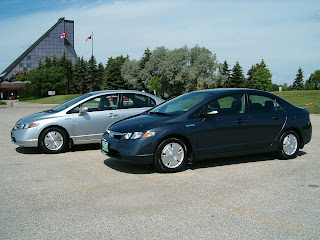
Well, the wife got her new hybrid, a 2007 Honda Civic Hybrid and she loves it. To commemorate we celebrated her new car and Canada's national day with a few photos taken at the Royal Canadian Mint (where the Canadian currency is made).
+Cars+only.JPG)
Humm, two civic hybrids in our household? Why not? They still weigh less (financially, environmentally, etc) than the numerous SUV's, Vans and large sedans parked in the majority of driveways across this great country. If you believe in better examples then you might just accept being the first to provide them. In other words, "Do as I do... and not just as I say".
+Cars+only.JPG)
Humm, two civic hybrids in our household? Why not? They still weigh less (financially, environmentally, etc) than the numerous SUV's, Vans and large sedans parked in the majority of driveways across this great country. If you believe in better examples then you might just accept being the first to provide them. In other words, "Do as I do... and not just as I say".
Subscribe to:
Comments (Atom)


