Saturday, May 2, 2009

2010 Honda Insight test almost done.

Our in-depth review of the 2010 Honda Insight is almost over and we're making a call for some feedback from the community of HI-II owners:

We're looking for feedback in the following areas:
  1. Specific attributes of driving behavior of the vehicle that impress you or not.
  2. Instrumentation benefits/detriments in everyday use.
  3. Have you noticed any fuel consumption patterns due to cold, driving regimen including observable differences between displayed versus computed mileage?
  4. How about the econ button? Have you used it or just kept it off? Your thoughts?
  5. Practicality. Did you exercise its cargo and/or passenger flexibility?
  6. Anything else you may wish to reference, including how this car may have changed your daily driving strategy.
You may email me or post your feedback here:

Impressions and general feedback


In the meantime, here's a snippet from the review vault:

Tuesday, April 28, 2009

You betrayed your hybrid message by endorsing a Diesel

In recent days, some folks have asked me why did I review a Diesel vehicle when I am such a staunch supporter of fuel efficient hybrids? Even more shocking, is why did I give such a good rating to this TDI at all even though it is nothing more than a Tier 2- Bin 5 vehicle?

These are all good questions, so let me explain in case I did not reflect that in my review well enough:

  • First of all, please note the qualifier “fuel efficient hybrids”, as I do not support all hybrids. In fact, I am more likely to support and endorse a clean Diesel car like this Jetta TDI, than I am of supporting a Toyota/Lexus hybrid SUV or GM hybrid SUV.
  • Second. Even though this 2009 Jetta TDI is still not as clean as I wished it could be, it still represents a significant amount of progress over what we have always known about past diesel tech. In my view we need more fuel efficient choices and as my review indicates, this particular car has an inherent fuel economy potential that simply cannot be ignored. In fact, compared to many gasoline only vehicles I would tend to regard this Jetta as a very attractive alternative to the 92% of vehicles on our roads today.
  • Lastly, if you read my review of the 2009 VW Jetta TDI, you'll also note that I did not say this Jetta is an alternative to a fuel efficient hybrid at all, but then again, neither Toyota nor Honda can make enough hybrids to satisfy the needs of our market.
So it stands to reason, that Clean Diesel has a definite place in our future and the only thing it needs to improve even further, is additional emissions scrubbing and some level of acceptance by the general public. With environmental concerns at an all-time high, a good amount of scrutiny is pressing Diesel car makers to improve so I am sure this is something to keep an eye on.

If anyone thinks that we'll make the most progress by pushing hybrids only then I would say they are seriously mis-calculating the market penetration hybrid tech can have for the next 10 or so year. The biggest constraint to accelerated hybrid proliferation we have remains the paltry production capacity which is unlikely to ramp-up fast enough to produce the benefits we seek.

But while that happens, we not only need good ideas to come to fruition in the engineering war-rooms of our auto manufacturers, but we also need to leverage whatever technologies we have today which constitute a measurable improvement in emissions and fuel usage. As I said many times before, with additional improvements in the Clean Diesel tech there's no reason why this technology cannot share the roads with the still evolving hybrid platforms for the next 10 years. Sure it may be several steps behind hybrid technology in emissions but so far it has proven that it can be as clean as the other 95% of the vehicles on our roads today. And with the mileage potential we demonstrated this is a good place to start at.


Sunday, April 26, 2009

The 2009 Volkswagen Jetta TDI review finally posted

Yes, it took a while but we wanted to make sure we had a chance to fully assess the fuel economy potential of this vehicle - with of course, a Canadian Spring time perspective added in. This also meant doing it with roads devoid of snow or ice and also with an opportunity to take the car through a variety of driving regimens.

If you wish to see how well a 2009 Jetta TDI can do under safe and fuel efficient driving please follow the link below.

CleanMPG - 2009 Jetta TDI review - (Canadian Comfortline model)

Enjoy.

Sunday, March 29, 2009

2010 Honda Insight - In depth review and FAQ coming soon.

Yes, the mainstream publications have already released a lot of Insight II specific photos and videos regarding Honda's newest hybrid vehicle...
But, what is it like to live with this car with regards to its abilities and fuel economy potential in a typical urban setting... especially on how it compares to its bigger brother the HCH-II? Here are a few additional questions:
  1. How does it hypermile and what techniques give you the most bang for your hypermiling buck?
  2. What about soft gliding and its ease of use?
  3. How's SoC management and what works best?
  4. How easy is it to manage the electric assist?
  5. What about the mid 3's mode for low speed urban commuting?
  6. How effective is the SAHM mode on the highway and what speed ranges can we expect SAHM to be sustainable?
  7. Pulse and Gliding?
  8. S-Mode accelerations?
  9. The ECO button?
  10. The temperature thresholds and how it compares to the warm stages of the HCH-II?

Well, I'm going to spend some quality time with a new 2010 Honda Insight over the month of April and my primary goal is to provide some of the answers to these questions. So, if you have additional requests and ideas please feel free to submit them for our consideration and testing. :)

By the way, here's an exclusive 2010 Honda Insight video for your enjoyment:


Monday, March 23, 2009

2009 Jetta TDI review coming soon...

This morning I had a little invitation from a local VW dealer. Yes, I was offered the opportunity to review a 2009 Jetta TDI and I am seriously going to consider it. Sure, I have a high amount of affinity for fuel efficient hybrid technology but I still believe cleaner Diesel tech has a very important role to play in our immediate future. ;)

Anyway, I hope the dealer understands that unlike most folks testing their cars, I will be walking into their dealership with a scangauge in hand and a dead-serious desire to drive the demo unit into the lowest L/100km I can get.

As soon as I get enough information and driving impressions on this vehicle I will publish the review at CleanMPG. In the meantime I'll post the little bits of info as I get them.

Saturday, March 21, 2009

Installing the LED taillights

After looking at the boxes for several days I decided I would give the installation a shot. Each box arrived with a different set of tail lights. I picked a set and opted to get my hands dirty with the task of prepping the car for the tail light replacement. This also meant securing an old blanket where I could temporarily rest the bumper and the taillights while working on the car.

The following is a brief summary of the major steps taken during this retrofit. A good set of tools is a must to avoid damaging the new and the OEM parts.

  1. If you have rear mudflaps you may have to remove them. To do this well you may also need to remove the rear wheels since we may not have enough clearance to remove the flaps.
  2. Then you have to remove a total of 4 screws on each side of the rear wheel well that are holding the bumper in place. Take care to note which screws go where in order to reverse the procedure later on - yes they are all slightly different.
  3. Then it is a matter on unbolting two high mounted screws (under the trunk lid) with a hex key and then carefully pop off the two clips at the bottom of the bumper.
  4. Once this hardware is out of the way and with the help of an assistant we pull out the bumper starting from the ends at each wheel well. An assistant will help hold the lightweight bumper without it falling on the ground - remember the bumper is a painted surface.
  5. The next step is to remove the trunk lining out of the way enough to gain access to each tail light. Remove the connectors and bulb from each taillight and take note which bulb came from which orifice.
  6. You need a good wrench to remove a total of 4 nuts out of each taillight. Once the nuts are removed we need to loosen up the metal bracket holding up each tail light. The single screw attaching the metal bracket to the bottom of the tail light also needs to come off completely. We do this to both taillights and gently remove the units.
  7. At this stage you are ready to unpack then new tail lights and slide them into the appropriate locations.
  8. Perform a readiness test before bolting everything back in. This may include pressing the brake pedal, turning on the marker lights and the hazard lights. If all looks good simply bolt everything back to the way it was. Make sure the water seal is properly positioned around the inner edge of the taillights otherwise you may end-up with some water in your trunk after a car wash.
The picture to the right shows the OEM and the new LED tail lights for the rear right side of the car. The top light is the OEM part and the bottom (with the attached load resistor) is the new assembly.

Some words of caution...
Make sure that you insert the new taillight connectors into the OEM wiring harness carefully since these are not as smooth and rounded as the OEM bulbs were and you may crumple the internal contacts in the OEM harness.

Also, as you may notice one of the new tail lights has a bad LED. I will be exchanging this one one of these days.

Was it worth it?

That's what I will be assessing over the next few days. At some point the full review of this accessory will be posted at www.CleanMPG.com. Anyway, the whole setup took about two hours to complete especially after you include the inner (trunk lid mounted) tail lights.

Here's a little video showing the tail lights in action. The side marker lights are on as well as the hazards.


Cheers;


Tuesday, March 3, 2009

Adding LED tailights to the HCH-II

A local group of HCH-II owners agreed to review a set of HCH-II tail lights that run mostly on high intensity LED arrays. These tail lights are complete assemblies that match the size of the OEM tail lights and only use a single stock incandescent bulb used for the backup light. The remaining light clusters are strictly LED based and the complete units are OEM plug and play.

Oh, yes. These units are DOT approved too. Here's a sample:


The candidate units will be Altezza, APC and ANZO branded and we will report on how they perform in terms of power usage. We expect these to perform as well as the OEM units in terms of lighting effectiveness, but we are not sure if these will actually consume less power. As you may know, the upcoming Toyota Prius has this feature and so does the 2009 Honda Insight. For good reasons, LED tail lights are expected to save a few percent in nominal energy over the more traditional lighting.

We have ours fingers crossed... as these tail light units are very expensive roughly $250 to $400 so we hope they work. If they don't, well... at least they will look OK.

Thursday, February 26, 2009

Update on the latest software updates for the HCH-II

Well, a couple of months have passed and I have a much better idea whether the latest updates actually improved things with regards to the occasional SoC crashes. Please check this post for actuall update details:

Software update part numbers

First let me summarize what the current behavior now is:
  1. Regen affinity is much higher during low throttle conditions while is the ICE is cold. This relates to the early temperature transition stages (S0 through S3).
  2. When SoC descends to 5 bars a forced regen is induced as it did before when it dipped below 5.
  3. SoC crashes still happen but these are detected before the SoC dips below 5 bars.
  4. Forced regens stop when the SoC reaches a full 8 bars
  5. Finally, forced regens usually jump from an SoC of 6 bars to 8. No smooth transitions as they did before.
This is the post update behavior in a nutshell and after a few months of living with it I can't say I am happy with it. I will be contacting Honda regarding the update and I will be forwarding my feedback especially since no additional updates have been placed on the channel.

I'll post additional info as soon as I get more information on this issue.

Monday, February 9, 2009

Life Cycle assessment for Honda and Toyota hybrids (HCH-II & Prius II)

I recently re-discovered a chart that had originally been published in one on Honda's 2007 environmental reports. In this chart Honda illustrates how much CO2 the Civic Hybrid produces above its gasoline only powered counterpart. The graph identifies the volume of CO2 produced during its first 100,000 Kilometers (62,000 miles) and it also identifies which aspect of the cars life (from production to use and disposal) contributes the most.
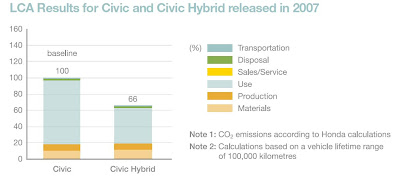

Let us just say, that when it comes to energy usage the Civic Hybrid produces far less CO2 and requires measurably less energy to operate for the first 100,000 km. Can you imagine how much of a discrepancy there would be if the study had been extended to 200,000 km?

What about the Toyota Prius, the most popular and ubiquitous hybrid in the world?


Pretty educational isn't it?

A few words:

Since these two graphs were published by the two largest global producers of of Hybrid electric vehicles in the world, they carry a fair amount of similarities and results. What is remarkable is that despite the additional amount of resources and energy their fuel efficient and capable HEV consume during their production, they will require relatively little time and mileage to best their conventionally powered siblings.

Yes, these graphs were provided by both Honda and Toyota and not an independent source but it is the best and most authoritative we can get, which is far more than the shameful guesswork CNW did during their much controversial study.

No wonder CNW never allowed their work and claims to be peer reviewed. :(

Tuesday, January 13, 2009

The Prius Detroit Connection event

Toyota issued invitations to 50 of the most active Prius owners to attend the unveiling of the new 2010 Toyota Prius in Detroit during the NAIAS event. We had folks from all over the continent (US and Canada) as well as Pat Sparks from Australia. Most of these folks were members of online communities (CleanMPG and PriusChat - both of which I am a member) and we not only had an opportunity to rub shoulders but we also managed to have a hands on experience with 3 distinct trim levels of the upcoming 2010 Prius.

Special thanks goes to Toyota for the extremely well organized event as well as the online community who tirelessly continue to make the Toyota Prius the pinnacle of excellence in the automotive world.

Anyhow, here are a few videos for your enjoyment:
The following is a detailed video of the power-train components (ICE and HSD). Please note the engine, the exhaust recirculation system and the more compact battery pack+cooling packaging.


The next two videos capture an interactive kiosk display that highlights the new developments on the 2010 Prius.


Monday, January 12, 2009

Live from NAIAS (Detroit) and the Prius 2010 PDC event

This years's North American International Auto Show event was underscored by the introductions of two very important vehicles: The 2010 third generation Toyota Prius and the 2010 second generation Honda Insight.

Here are some videos of the event:

The 2010 Honda Insight


The 2010 Toyota Prius


More to come ...

Friday, December 26, 2008

New HCH-II software updates (Winter 2008)

I had promised a few months ago that I would send notice of new software updates for owners of 2006, 2007 and some 2008 models. I have not confirmed if one or all of these updates apply to newly produced 2009 models.

This is it folks. We have a new batch of software updates that are purported to address some of the issues experienced by owners of the said model years.

Since at the moment I can only mention part numbers and a description, I am hopeful that this will be enough when you request the application of the updates from your dealer. If this is not enough then please let me know and I'll fetch additional info on these part numbers.


Part# 19301PMX306
Desc: PGM-FI Update + additional update

Part# 37820-RMX-A53
Desc: Battery Initial Calibration

Part# 1K100-RMX-A06 (S/B# 01-084...)
Desc: Battery Update + additional update

Part# 1K100-RMX-A06 (S/B# 03-002...)
Desc: Motor Update + additional update


I will be scheduling an appointment from my local dealer to have these updates applied to my two HCH-II's and hopefully some of you will be able to do the same at some point.

Perhaps these updates will offer an improvement for some of the issues concerning the community over the last year or so. ;)

Thursday, November 20, 2008

The Honda Civic Hybrid (HCH-II FAQ) Frequently Asked Questions

This one has taken me a fair amount of time to complete... you know, in the priority list of things to do some of those things end-up taking a bit longer.


Anyhow, this FAQ article is a must read by any HCH-II owner as well as anyone else looking to purchasing one.

The Second generation Honda Civic Hybrid FAQ

Enjoy.

Monday, November 3, 2008

A Hybrid Owner’s winter survival guide

Yes, after almost 14 months it is complete and you may find it here:


A Hybrid Owner’s winter survival guide


My hope is that this article will help Prius and HCH-II owners overcome the fuel economy hit due to winter time driving. As with anything else in life, a bit of knowledge and upfront preparation can do wonders for your emissions and fuel economy.


Highlight: Temperature transition table for the Prius-II


Highlight: Temperature transition table for the HCH-II


You'll find a lot more detail in that article.

Enjoy :)

Tuesday, June 3, 2008

Finnally, hypermiling to be taught in Driver's Ed... Well not quite there yet

Well, the ball is in motion and I may have found a level of receptiveness with some at MPIC (Manitoba Public Insurance). There is a general agreement that including references to eco-driving principles in the Driver's ed handbook is a good thing. What concerns me is the level of detail (or lack of) as well as the lack of driver testing in this particular area. I sure would like to see the word "hypermiling" used in the literature but given that this is something of a first, I will understand the reluctance and the rather timid approach.

In any case, smaller steps forward are better than no steps at all... but despite this the effort forward continues.

For furhter details on hypermiling and eco-driving please visit us at WWW.CleanMPG.COM